| |
|
|
|
Timber Framing Styles: Close Studding.
|
|
| |
|
 |
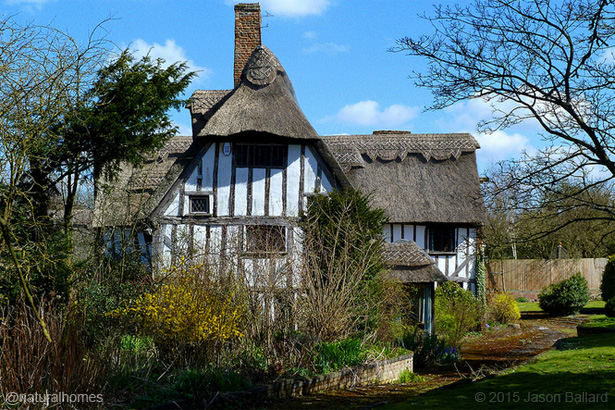
Cottage, Therfield, UK |
 |
|
|
|
|
|
|
|
Close studding is really just a British
variation of the
Half-Timbered technique in which vertical
timbers (studs) are positioned close together, dividing the
wall into much more narrow panels than usual.
The studs in this style of timber framing are not structural
elements of the frame, they are there purely for aesthetic
reasons, to produce an impressive front that was mostly found on
expensive buildings. |
|
|
 |
|
| |
|
|
|
|
|
|
|
|
|
|
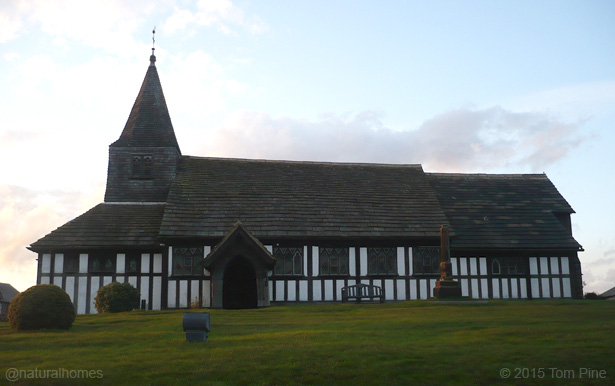
Church,
Marton, Cheshire, UK |
|
|
|
|
There are even a few examples of churches from this era that
employed this half-timbered style. One of the oldest and most well
preserved examples is St James' and St Paul's Church (right) in the
village of Marton in Cheshire, UK.
The style appeared in England during the 13th century but didn't
become common until the mid-15th century when it also became
popular in France. The style remained fashionable up to the end
of the 17th century.
In the beginning the studs were spaced about
the same distance apart as the width of the studs. It was around the middle of the
16th century when people began making the spacing wider. The studs
themselves could either span the entire height of a storey or were
divided by an intermediate rail. Diagonal braces were also
implemented to give the frame stability. |
|
 |
|
|
|
|
|
|
|
|
|
|
|
|

